
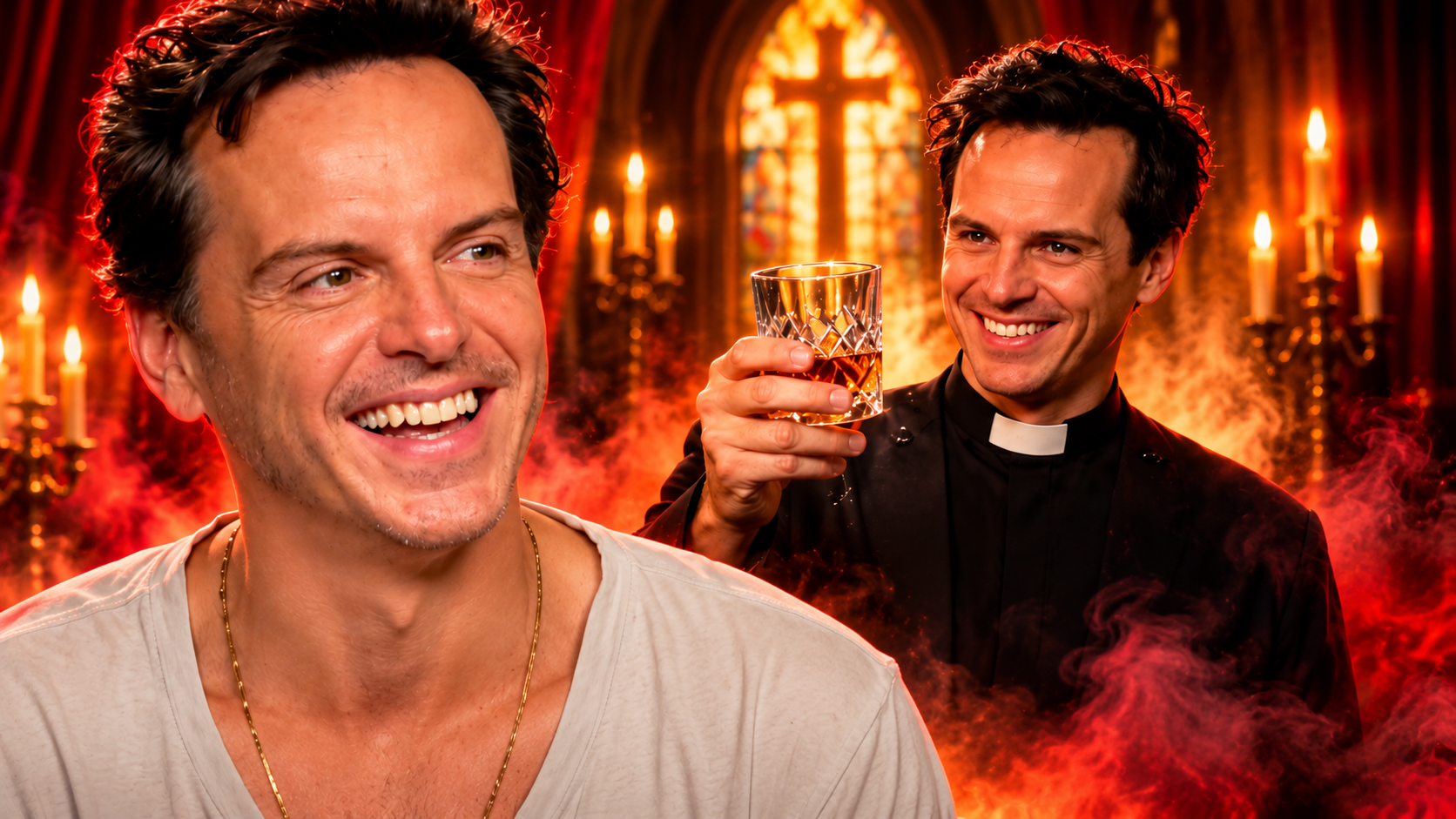
It has been more than seven years since Andrew Scott walked away from Fleabag at a bus stop, told her their love would pass and then wandered off into the night while being followed by a fox, leaving millions of viewers simultaneously heartbroken and apparently destined to spend the rest of their lives asking one question: what happened to the Hot Priest?
Well, it turns out Andrew Scott would quite like to know too.
I caught up with Andrew for The Movie Dweeb to talk about his D-Day drama Pressure, in which he plays real-life meteorologist James Stagg, but after noticing that his career has now returned him to the Second World War on several occasions, I decided to create something absolutely nobody had requested: the Andrew Scott D-Day Cinematic Universe.
That gave me an excuse to ask which of his previous characters he would most like to revisit for a day, and after considering the question, there was one particular role that immediately came to mind.

“It would be good to see what the old Priest is doing from Fleabag,” Andrew told me, before immediately crushing any hopes that this was a carefully orchestrated announcement for Fleabag Season 3. “It’ll never happen, I should add.”
Still, the fact that Scott himself remains curious about where the Priest ended up feels significant given just how much that character continues to mean to audiences. “That’s a story that people are still very invested in,” he said, at which point I naturally pretended I’d never heard of the series and asked him to explain exactly what this mysterious “Flea Bag” was.
Scott joked along before explaining that part of the appeal of revisiting the character is precisely because he doesn’t expect us ever to find out what happened next. “I think the likelihood is that we won’t see what happened to them,” he said. “So, it’ll be interesting.”
And yet, in the same answer, Andrew made a pretty convincing argument for why the Hot Priest shouldn’t return. He described making Fleabag as a “wonderful experience” and the series itself as a “very special piece of work”, before reflecting on the enormous response it received from audiences.
“When those things happen, when you’ve had an amazing experience, in some ways it’s probably best to leave those things alone, actually,” he admitted.
Personally, I possess nowhere near that level of artistic restraint. As I told him, if I’d played the Hot Priest, I would still be wheeling the character out at every available opportunity while sitting on a golden throne surrounded by marble statues of Phoebe Waller-Bridge.
“You can still do that,” Andrew helpfully pointed out.
Phoebe, if you’re reading this, apparently I now have Andrew Scott’s blessing.
Why Andrew Scott’s Hot Priest Became A Fleabag Phenomenon
Created and written by Phoebe Waller-Bridge, Fleabag began life as her one-woman stage show before becoming a BBC television series in 2016, with Waller-Bridge playing its unnamed, chaotic and spectacularly self-destructive central character.
The first series was already acclaimed, but when Fleabag returned for its second and ultimately final season in 2019, Waller-Bridge introduced Andrew Scott as a Catholic priest who gradually develops an intense relationship with Fleabag. The internet quickly christened him the “Hot Priest”, despite Scott later pointing out that the character was conceived simply as “The Priest” before viewers decided to make the whole thing considerably hornier.

What followed became one of the defining television romances of the decade. Their relationship allowed Waller-Bridge to explore faith, loneliness, intimacy and love while also producing scenes that would permanently alter the way an entire generation behaved whenever somebody said the word “kneel”. Scott has previously explained that he and Waller-Bridge spent hours discussing religion and love together before the season was written, conversations which subsequently helped shape what appeared on screen.
The second series ultimately became an awards juggernaut, with Fleabag winning Outstanding Comedy Series at the 2019 Primetime Emmy Awards alongside wins for Waller-Bridge’s writing and lead performance, while the series’ supporting cast included Sian Clifford, Olivia Colman, Brett Gelman and Fiona Shaw.
More importantly for anybody still emotionally damaged by that bus-stop scene, neither Waller-Bridge nor Scott has spent the years since desperately trying to manufacture another chapter. That is what makes Andrew’s answer so interesting: there is clearly still affection and curiosity there, but also an understanding that sometimes the reason people desperately want more of something is because you actually knew when to stop.
Which is very mature and artistically sensible.
I still want to know what happened to the fox.
Andrew Scott Plays The Man Who Helped Decide The Fate Of D-Day In Pressure
The reason Andrew was actually sitting opposite me was Pressure, director Anthony Maras’ historical drama about the extraordinary true story behind one of the most important decisions of the Second World War.
Set across the tense 72 hours leading up to D-Day, the film stars Scott as Scottish meteorologist Captain James Stagg, whose weather forecasting put him at the centre of an almost unimaginable decision. With the Allied invasion assembled, Stagg had to convince General Dwight D. Eisenhower that worsening weather conditions made the planned date dangerously unsuitable, leaving Eisenhower to decide whether to postpone the operation or proceed with potentially catastrophic consequences. Brendan Fraser plays Eisenhower, alongside a cast including Kerry Condon, Chris Messina and Damian Lewis.
I admitted to Andrew that I wasn’t prepared for how much I loved the film. Going into a movie about the meteorological forecasting behind D-Day, there is perhaps an understandable fear that somebody is going to spend two hours pointing at a cloud and explaining atmospheric pressure to you. Instead, Pressure turns uncertainty itself into the source of suspense.

Scott’s James Stagg is crucial to that because the film resists turning him into the conventional Hollywood version of a wartime hero. There are no enormous inspirational speeches designed to make him immediately lovable; he is stubborn, obsessive, frequently abrasive and far more interested in getting the weather forecast right than winning anybody’s affection.
That, Andrew told me, was exactly what attracted him to the character.
“That was the chief pleasure when I first read the script,” he explained. “You think, ‘Oh, this is sort of an anti-hero in some ways.’ He’s somebody that is not concerned with being charming. He’s not the superhero. He’s not particularly likeable. He’s not friendly. He’s obsessed with the weather. He doesn’t smile.”
Rather than attempting to soften those qualities, Scott deliberately leaned further into them. Because the audience is already being encouraged to follow Stagg’s perspective, he didn’t believe the character needed to win us over with movie-star charm.
“Even if we don’t really like him at the beginning, eventually we start to at least respect him,” Andrew said. “And I think by the end, hopefully, we really do go, ‘Okay, this guy is actually what I describe as a really good person, not necessarily a really nice person.’”
It is a distinction that gets right to the heart of Pressure. Stagg doesn’t need everybody in the room to like him; he needs them to believe him when he tells them something they desperately don’t want to hear.
Acting Opposite Brendan Fraser Was Intimidating For Andrew Scott
That stubbornness becomes particularly effective when Stagg goes up against Brendan Fraser’s Eisenhower, because Fraser has an enormous physical presence in the film while Scott’s character is essentially armed with knowledge, conviction and an unwillingness to back down.
Andrew admitted that acting opposite Fraser genuinely affected the dynamic of those scenes, regardless of how much preparation had happened beforehand.
“You can imagine the way a scene is going to go as much as you like, but until you’re in front of the other actor and you see that, that becomes a live experience,” he explained.

“Brendan is incredibly physically imposing. He was not afraid to shout at me. And so my job was to try and not let that affect me. Sometimes that was a difficult thing to do, not to be intimidated.”
Scott described Stagg as being “like a shark”, possessing an internal strength that allows him to hold his ground even while surrounded by enormously powerful military figures. That makes the confrontations with Fraser particularly compelling because Stagg’s weapon isn’t physical strength or rank; it is the uncomfortable possibility that he might be right.
For the record, Andrew and I then agreed that Brendan Fraser is obviously a “terrible toxic human being”, “horrible”, “unkind” and a “monstrous person”.
This was sarcasm.
Please do not make Brendan Fraser sad because of me.
Andrew Scott Says You Can Never Know If A Movie Will Be A Hit
One of the central frustrations facing Stagg in Pressure is that he can never offer the certainty everybody wants from him. He can analyse the available information and make the strongest possible forecast, but when people demand to know whether he is 100 per cent sure, the answer simply cannot be yes.
That gave me the chance to ask Andrew whether acting feels similar.
After a run spanning Fleabag, All of Us Strangers, Ripley, Wake Up Dead Man, Blue Moon and now Pressure, can Andrew Scott read a screenplay and know with complete certainty that something is going to work?
“I don’t think it’s ever 100% because it’s such a collaborative process,” he told me, explaining that his strongest indicator is still the script. “If you have a real feeling and the script’s got some flair in it, you go, ‘Okay, well, that’s got a real signature on it.’”
Even then, assembling acclaimed actors, filmmakers and writers guarantees absolutely nothing.
“They say in this industry, famously, nobody knows anything,” Andrew said. “You think, okay, we’ve got those actors, we’ve got this director, we’ve got this script from the makers of this, blah blah blah… Huge flop. Or the opposite.”

He described filmmaking as a kind of “alchemy”, although his instincts have occasionally told him that something was genuinely special before audiences eventually agreed.
And occasionally, of course, those instincts have gone the other way.
“I’ve had the opposite as well where I’m like, ‘Oh, this is going to be great…’”
Andrew didn’t finish that sentence.
He really didn’t need to.
Pressure Also Made Andrew Scott Think About His Mum
There was one final part of our conversation that took the interview somewhere unexpectedly moving.
Before watching Pressure, I knew remarkably little about James Stagg despite the extraordinary responsibility he carried in the days before D-Day. The film therefore made me wonder how many people have lived lives worthy of being dramatised without most of us ever learning their names.
So I asked Andrew whose true story he would most like to see told.
“The first person that I think of is my mum,” he said.
Andrew’s mother, who died a couple of years ago, was a teacher, and he spoke beautifully about the enormous impact she had not only on him and his siblings, but on generations of students whose lives she encountered through her work.
“I often think about the legacy of the enormous effect that she had,” he explained, before reflecting on the “quiet heroes in our life” whose apparently ordinary stories can contain extraordinary acts of “generosity and kindness and spirit”.
“How do you make that into a film?” he wondered.
Naturally, I immediately auditioned myself to play Andrew Scott in this hypothetical movie about his mother’s life, complete with an Irish accent so astonishing that I may have single-handedly ended my acting career before it had even started.
Andrew listened to my attempt, paused and delivered the only feedback necessary:
“Bye.”
Honestly, I think Phoebe Waller-Bridge would have loved it.
For more Hot Priest revelations, spectacularly unsuccessful auditions and interviews that somehow turn D-Day into the Andrew Scott Cinematic Universe, follow The Movie Dweeb on YouTube and TikTok.

Leave a Reply